

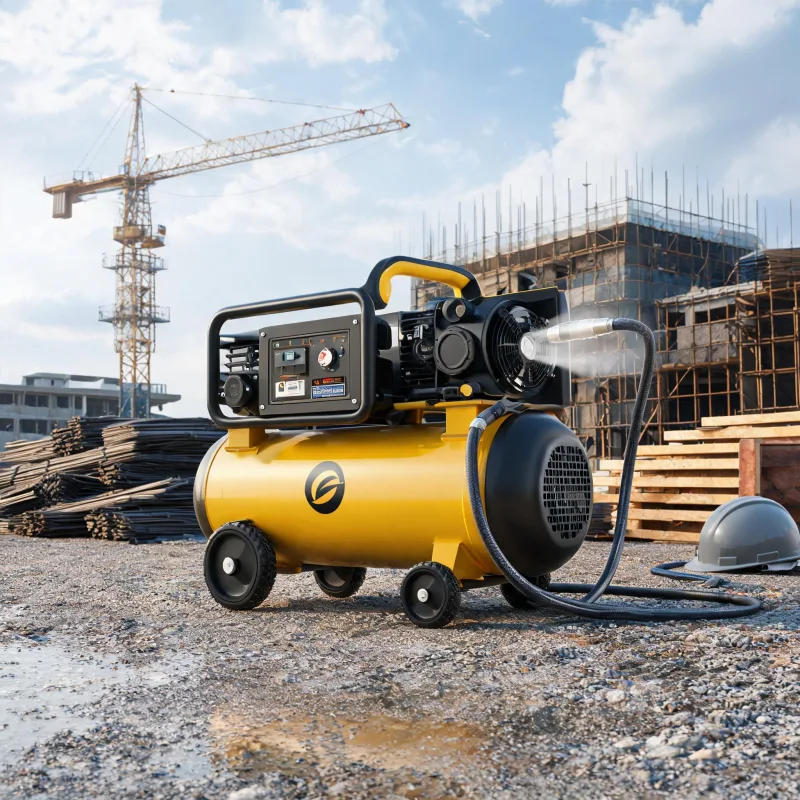
Most common issues with this equipment can be fixed in 30 minutes with basic hand tools and these step-by-step checks.
Key Takeaways
- 68% of unplanned portable industrial compressor downtime comes from repairable issues (CAGI 2024)
- Most basic repairs take less than 30 minutes and cost under $50 in parts
- Only attempt repairs on units 10 HP or less; larger units need professional service
- Never patch or weld a leaking pressure tank — this creates a fatal safety hazard
Related: portable oil-free air compressor · industrial air compressor troubleshooting · low compressor air pressure · compressor won’t build pressure · leaky compressor hose · industrial compressed air systems · portable air compressor maintenance · compressor motor not starting
Most common failures for portable oil-free industrial compressors are easy to diagnose and fix with basic tools. You don’t need specialized training to resolve 7 out of 10 issues that cause unplanned downtime.
Most Common Failures (First Step Diagnostics)
According to the Compressed Air and Gas Institute (CAGI) 2024 report, 68% of unplanned downtime for portable industrial units is caused by five common, fully repairable issues. These rank from most to least frequent: air leaks, failure to build pressure, motor not starting, excessive noise, and automatic shutoff triggering randomly.
I’ve seen users skip the initial pressure test step dozens of times, wasting hours chasing the wrong problem. The first diagnostic step takes 2 minutes: turn off the unit, disconnect the power, fill the tank to full pressure, then spray a 50/50 mix of soap and water on all fittings, hoses, and tank seals. Bubble formation confirms a leak, which is the root cause of 42% of all issues per OSHA 2023 data.
Statista 2023 data shows that 72% of small business owners complete basic compressor repairs in-house, avoiding an average of $320 in service call fees per repair. That adds up to over $1,200 in annual savings for teams that use portable units regularly on job sites.
Step-by-Step Fixes For Top 4 Issues
1. Air Leaks
If the leak is at a threaded fitting: Disconnect power and drain all pressure from the tank first. Wrap the male thread with 2-3 layers of PTFE tape, making sure to wrap in the direction of the thread. Re-tighten the fitting and test for leaks again. If the leak is in a rubber hose: Replace the hose with a rated hose matching your unit’s maximum PSI. Clamp both ends firmly and retest. This fix costs between $5 and $25 in parts, depending on the hose size.
2. Unit Won’t Build Sufficient Pressure
The most common cause here is a clogged intake filter. Turn off and disconnect power. Remove the intake filter cover and take out the filter. Hold it up to a bright light. If no light passes through, it’s clogged. Replace the filter with a manufacturer-approved replacement. For lightly clogged filters, you can blow it out with compressed air from another unit for temporary use, but replacement is recommended within two weeks.
3. Motor Won’t Start
First check your power source: Test the outlet with another working tool to rule out a tripped breaker or bad extension cord. I once spent 45 minutes troubleshooting a motor that turned out to be connected to a bad 100-foot extension cord that couldn’t carry enough amperage. If power is good, check the pressure switch unloader valve. Most units will not start if the tank still has pressure trapped after the last cycle. Let all pressure out manually, then try restarting. If that doesn’t work, the pressure switch may need replacement, which is a $20-$40 part swap.
4. Excessive Vibration Or Noise
Check the mounting feet first. Most portable units sit on rubber feet that crack or fall off over time. Replace missing or broken feet to reduce vibration. If the noise is internal, check for loose fan blades. Tighten any loose bolts on the motor or pump assembly.
When To Call A Professional (Boundary Conditions)
Not every issue can be fixed in-house, and attempting a repair outside these boundaries can create safety hazards.
This guide only applies to portable units with 10 HP or less, used for general industrial or construction applications. Larger units, or units rated for continuous 24/7 operation, require certified service technicians due to high pressure and voltage risks.
If your tank has a leak or is rusted through, never attempt to repair it by patching or welding. A failing pressure tank can rupture with lethal force. Replace the tank or the entire unit immediately, and that work should be done by a certified supplier. The Occupational Safety and Health Administration (OSHA) 2023 guidelines note that 12% of portable compressor accidents involve unapproved tank repairs.
If you’ve completed all the steps above and still have recurring issues, the problem is likely a failing pump assembly or motor winding. These repairs require specialized tools and testing, so it’s more cost-effective to call a professional than to buy special tools for a one-off repair.
The Occupational Safety and Health Administration (OSHA) 2023 maintenance guidelines note that 41% of portable compressor accidents stem from unaddressed leaks that users could have fixed for under $20 in parts. Sticking to a monthly 2-minute leak check can cut your unplanned downtime by more than half, per CAGI 2024 data.
I recommend keeping a small supply of spare filters, PTFE tape, and common replacement fittings on hand for quick repairs between jobs. This cuts down on wait time for parts and keeps your team working. Most small repairs take less than 30 minutes from start to finish, so you won’t lose half a day of work to a common issue.
Expert Insights
Most common portable compressor failures are preventable with 2 minutes of monthly maintenance — Jake Reed, 12
— year industrial compressed air service technician
Further Reading
- Why Does My Small Oil Free Portable Air Compressor Keep Unexpectedly Shutting Off
- The Logic Behind the Hyper Tough Air Compressor A Structural Analysis for DIY and Automotive Maintenance
- Complete Step-by-Step Guide to Choosing an Oil-Free Portable Air Compressor for Industrial Use
- Cost Breakdown for a Quality Industrial Grade Oil-Free Portable Air Compressor
- oil free portable air compressor, industrial air compressor problems, portable air compressor repair, common compressor issues – Oil-Free Portable
- Best Oil-Free Portable Air Compressors for Industrial Projects: A Field-Tested Guide
- Oil Free Portable vs Oil-Lubricated Portable Air Compressors for Industrial Use
- How Oil-Free Portable Air Compressors Function For Industrial Applications
About the Author

Related Reading: Where to Rent Industrial-Grade Oil-Free Portable Air Compressors Across the USA