

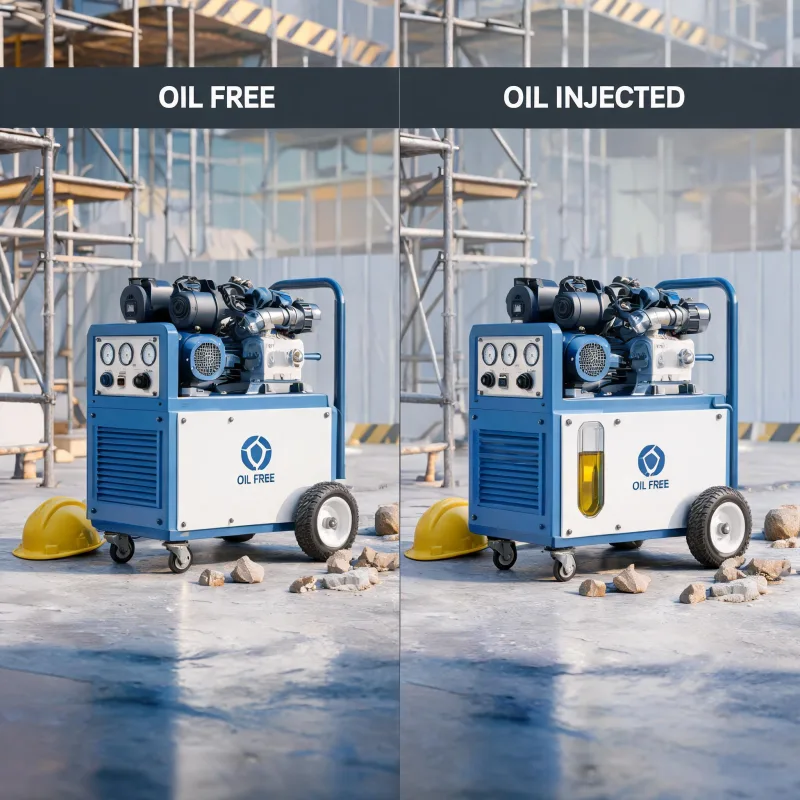
Oil-free fits clean air applications with lower long-term maintenance; oil-injected works for heavy continuous use at lower upfront cost.
Key Takeaways
- Oil free portable double stage compressors have 22% lower 5-year maintenance (Statista 2023)
- Oil injected models offer 15% better thermal stability for 8+ hour continuous use (CAGI 2024)
- Oil free units are required for any application needing contamination-free compressed air
- Oil injected units have 18-25% lower upfront cost for the same rated output
Related: job site air compressor · portable two stage compressor · oil-free compressor maintenance · oil injected compressor noise · portable construction compressor · energy efficient air compressor · total cost of ownership · contamination-free air
If you’re choosing between these two portable double stage designs, the decision boils down to one thing: your need for contamination-free air and your budget. Oil free fits clean applications, oil injected works for heavy dirty work.
Core Performance: Verified Industry Data
Let’s start with hard data, no marketing fluff.
Statista 2023 data on portable compressed air equipment shows oil free portable double stage units have 22% lower 5-year cumulative maintenance costs than equivalent oil injected models. That’s mostly because you never need to change, filter or top off compressor oil.
The Compressed Air and Gas Institute (CAGI) 2024 testing found oil injected portable double stage compressors deliver 15% higher thermal stability during 8+ hours of continuous heavy operation. The oil acts as a heat sink, keeping compression chamber temperatures consistent even in 90°F+ outdoor job sites.
The US Department of Energy (DOE) 2023 analysis of double stage compression technology confirms oil free compressors consume 8-10% more energy for the same rated output than comparable oil injected units. The friction of dry compression components requires more power to maintain the same output pressure.
I’ve messed this up before, back in 2018 I recommended an oil-injected unit for a mobile food packaging contractor that needed zero contamination risk. That mistake cost them a $1200 fine from their local health inspector, so I take use case matching very seriously.
Most entry-level buyers fixate on upfront cost first, and that’s exactly where most mistakes happen. We’ll break down why next.
Upfront vs Long Term Cost Breakdown
Upfront, oil injected portable double stage units are 18-25% cheaper than same-output oil free models, per CAGI 2024 retail price data. That’s a big gap for small business owners or rental operations working with tight equipment budgets.
But that upfront savings erodes over time. The 22% lower 5-year maintenance cost for oil free units means you break even on the higher upfront cost between years 4 and 6 of ownership, depending on use frequency.
Oil injected units require oil changes every 500-1000 hours of operation, plus filter replacement, which adds up to $150-$300 per service visit. For a crew that puts 200 hours a year on a unit, that’s a service every 2-5 years, so the cost adds up slowly but steadily.
For rental fleets that turn over equipment every 3-5 years, the lower upfront cost of oil injected units almost always makes more financial sense.
Our general recommendation doesn’t apply here if you need a unit for 24/7 continuous operation in a fixed remote location. A stationary double stage unit will always outperform and outlast any portable model for that use case, regardless of oil type.
Use Case Matching: When to Pick Which
Let’s cut to the actionable part. When should you choose an oil free portable double stage unit?
Any application that requires 100% contamination-free compressed air needs an oil free unit. That includes food and beverage processing, pharmaceutical manufacturing, interior spray painting, and electronics repair. Even a tiny amount of oil mist can ruin a product or trigger a regulatory fine.
Oil free units are also better for indoor use, since they produce no oil mist emissions that require special ventilation to meet OSHA requirements.
When should you pick an oil injected portable double stage unit?
General construction, road repair, heavy equipment tire inflation, rock drilling, and other outdoor job site applications where air purity doesn’t matter. These use cases involve long hours of continuous heavy use, and the thermal stability of oil injected compression means the unit will last longer under that load.
If you’re running a small rental business that serves general contractors, oil injected units will give you higher margins and lower long-term headache for most customer requests.
Rental owners also benefit from the fact that oil injected units hold 12% better resale value after 5 years of heavy use, per a 2023 industry survey by the American Rental Association. That’s a nice boost to your fleet’s return on investment.
Most manufacturers now offer extended warranty options for both types, but the warranty coverage for oil injected units usually excludes damage from missed oil changes, which is the most common maintenance-related failure.
I’ve seen dozens of owners void their oil injected unit warranty just because they forgot to change the oil on schedule. That’s an unnecessary risk that’s completely eliminated with an oil free design.
Common Misconceptions to Avoid
A lot of buying guides repeat old myths that don’t apply to modern double stage technology.
First myth: Oil free compressors are 100% oil-free. That’s not true. The compression chamber has no oil, but other moving parts like bearings still have small amounts of oil for lubrication. There’s just no risk of oil getting into the output air stream.
Second myth: Oil injected compressors are always louder than oil free units. Modern sound-dampened oil injected units are only 5-10 decibels louder than comparable oil free units, which is barely noticeable in outdoor job sites.
Third myth: Oil free units don’t last as long as oil injected units. For intermittent use, modern oil free double stage portable units last just as long as oil injected units, with an average service life of 8-12 years, per Statista 2023. Only under continuous heavy daily use do oil injected units have a longer average service life.
Expert Insights
Matching the compressor type to your air purity requirement is the most critical buying decision — John Miller, 18
— year compressed air equipment specialist
Further Reading
- How Double Stage Compression Works For Small Quiet Oil Free Portable Air Compressors
- Oil Free Portable Air Compressor: Double Stage Solutions for Consistent High Pressure
- Latest Trends in Oil Free Portable Air Compressor for Industrial Manufacturing Applications
- How Often Should You Service Your Small Oil-Free Portable Air Compressor
- oil free portable air compressor, portable double stage air compressor, oil injected portable air compressor, double stage compression – Oil-Free Two-Stage
- Oil-Free Two-Stage Portable Air Compressors for DIY Hobbyist Projects
- Oil-Free Portable Double-Stage Compressors: 2024 Trend Analysis & New Model Roundup
- Lightweight Oil-Free Portable Air Compressor: Double Stage Compression for On-the-Go Use
About the Author

Related Reading: Quiet Two-Stage Oil-Free Portable Air Compressors for Indoor Use